Crowded Corners
Some parts of the pond are packed with ducks. Other parts are nearly empty.
The Distribution
Stand by any pond long enough and you'll notice the ducks aren't evenly spread out. They cluster.
Maybe there's a corner where someone tossed breadcrumbs yesterday - fifteen ducks bunched together in a space the size of a kitchen table. Over on the opposite side, the water is nearly still, with just two or three ducks drifting in the open space.
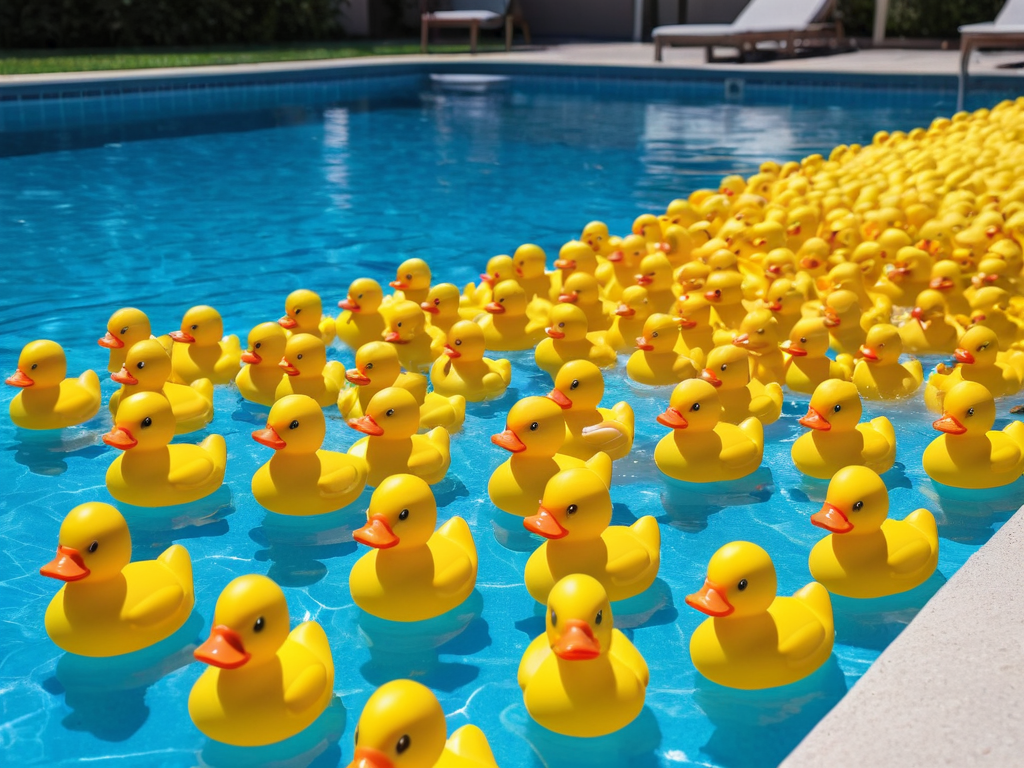
The pond is the same size everywhere. But the density changes dramatically depending on where you look.
Finding One in a Crowd
"See that duck over there?"
If you're pointing to one of the two ducks in the open water, I know exactly which one you mean. There are only two options. Even if your pointing is slightly ambiguous, even if I'm standing at a different angle, I can narrow it down quickly.
But if you're pointing at the crowded corner?
Fifteen ducks, all floating within a meter of each other. Some facing left, some facing right, some with their heads tucked, some paddling slowly. Your finger points in that general direction.
"Which one?"
You know which one you mean. But from where I'm standing, with all those ducks overlapping from my perspective, compressed together, it's almost impossible to tell.
Why Clustering Happens
Ducks cluster around resources. Food, shelter, safety in numbers. The corner with breadcrumbs attracts more ducks. The open water, with nothing of interest, stays sparse.
In semantic space, concepts cluster the same way. Ideas that relate to each other, that share properties, that connect through common features - they float close together.
"Machine learning" and "neural networks" and "deep learning" are all in the same crowded corner of conceptual space. They overlap, they relate, they're hard to distinguish without careful attention.
"Quantum physics" might be floating in a different part of the pond entirely, with plenty of empty space around it, easy to point to, easy to identify.
The Challenge of Dense Spaces
When concepts are packed tightly together, small differences in wording create big ambiguity.
Imagine pointing at the crowded corner and saying "the brown duck." Five of them are brown. Your description eliminated ten ducks, but left five possibles.
"The brown duck facing left." Okay, now we're down to two.
"The brown duck facing left, near the edge of the cluster." Got it. One duck.
But if you'd pointed at one of the isolated ducks in open water? "That duck" would have been enough. No need for multiple qualifiers. The sparse space makes pointing easy.
Sparse vs Dense
In the open water, ducks are islands. Point anywhere in that general direction, and it's clear which duck you mean. There's space between them. Breathing room. Your gesture doesn't need to be precise.
In the crowded corner, precision matters. Every duck is touching another duck's wake. Your pointing finger needs to be exact, or your description needs to be detailed, or both.
What This Means for Communication
When you're talking about concepts in sparse semantic space - unique ideas, unusual combinations, distinct topics - communication is easy. There's not much else nearby. Even vague gestures work.
When you're talking about concepts in dense semantic space - common words, overlapping meanings, subtle distinctions - communication gets harder. The concepts are bunched together. You need more precision, more context, more careful description.
"Love" is in a very crowded corner. Romantic love, familial love, platonic love, love of activities, love of objects - all clustered together, all overlapping. Point at "love" and you might be indicating any of a dozen related but distinct concepts.
"Thermodynamic entropy" is in sparser water. There are related concepts nearby, sure, but there's breathing room. Point at it and people generally know what you mean.
The Density Map
If you could see the pond from above, you'd see the clusters clearly. Dense regions where ducks pack together. Sparse regions where they spread out.
If you could see semantic space from above, you'd see the same thing. Some conceptual neighborhoods are crowded - common words, everyday ideas, overlapping meanings all packed together. Other neighborhoods are sparse - technical terms, specialized concepts, unusual combinations floating with space around them.
Where you're pointing matters. But just as importantly, how crowded that area is matters.
The Takeaway
Communication in sparse space is easy. Communication in dense space requires precision.
When you're pointing at a duck in open water, a vague gesture works. When you're pointing at a duck in a crowded cluster, you need to be specific.
The same is true for concepts. Some ideas float in isolation. Others are packed into tight clusters where small differences in description point to completely different meanings.
Know where you're pointing. Know whether the space is crowded or clear.
Part of the Duck Pond Experiments series - making abstract concepts concrete.